-
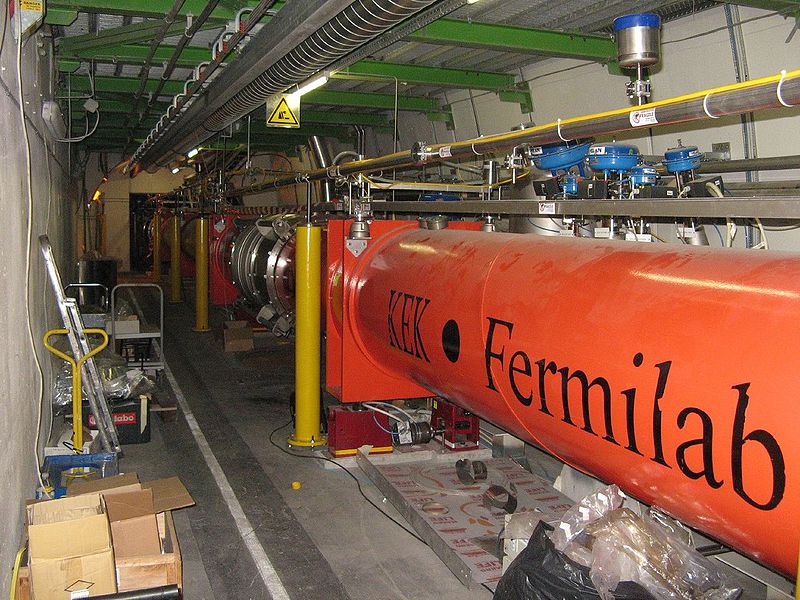
The LHC is installed in a tunnel 3.8 m. in diameter, buried 50 to 175 m. below ground. The tunnel straddles the French-Swiss border to the North-West of Geneva. [see map above]
-
Two counter rotating beams are injected into the LHC from the SPS accelerator (the Super Proton Synchrotron).
-
The proton beams are injected at 450 GeV and then accelerated to 7 TeV.
-
The beam moves around the LHC ring inside a continuous vacuum chambers which pass through a large number of magnets.
-
1232 dipole magnets bend the beam around the 27 km. ring. The momentum of the beam is very high and these magnets have to produce a very strong magnetic field.
-
To reach the high magnetic field required, high currents are needed. To avoid excessive resistive losses, the magnets are superconducting. A huge cryogenics system is required to produce the liquid helium needed to keep the magnets cold.
-
The cables of the magnets are of a very special design and conduct current without resistance in their superconducting state
-
The beams will be stored at high energy for 10 to 20 hours (with a bit of luck). In 10 hours the particles make four hundred million revolutions around the machine. During this time collisions take place inside the four main LHC EXPERIMENTS.
Wednesday, September 10, 2008
Introduction


Research
When in operation, about seven thousand scientists from eighty countries will have access to the LHC. Physicists hope to use the collider to test various grand unified theories and enhance their ability to answer the following questions:
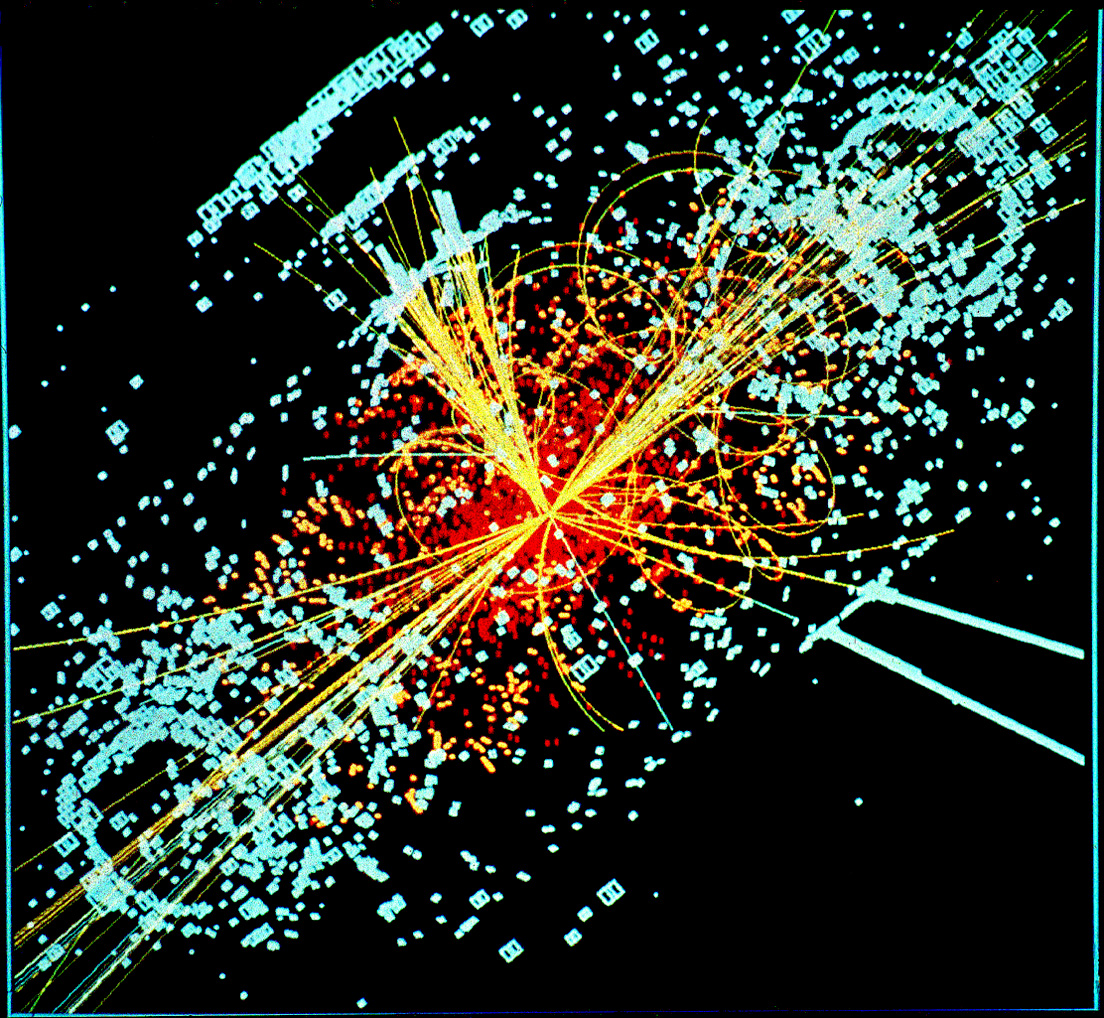
- Is the popular Higgs mechanism for generating elementary particle masses in the Standard Model realised in nature? If so, how many Higgs bosons are there, and what are their masses?
- Will the more precise measurements of the masses of the quarks continue to be mutually consistent within the Standard Model?
- Do particles have supersymmetric ("SUSY") partners?
- Why are there apparent violations of the symmetry between matter and antimatter See also CP-violation.
- Are there extra dimensions indicated by theoretical gravitons, as predicted by various models inspired by string theory, and can we "see" them
- What is the nature of dark matter and dark energy
- Why is gravity so many orders of magnitude weaker than the other three fundamental forces
- Is time travel (utilising either General theory of relativity or wormholes or black holes) possible
Renowned British astrophysicist Stephen Hawking has bet £50 the mega-experiment will not find the elusive particle seen as the holy grail of cosmic science. "I think it will be much more exciting if we don't find the Higgs. That will show something is wrong, and we need to think again. I have a bet of 100 dollars that we won't find the Higgs," said Prof Hawking.
Prof Hawking said the experiment could discover superpartners, particles that would be "supersymmetric partners" to particles already known about. "Their existence would be a key confirmation of string theory, and they could make up the mysterious dark matter that holds galaxies together," he said on the BBC. "Whatever the LHC finds, or fails to find, the results will tell us a lot about the structure of the universe," he saidLHC Cooldown Status

Large Hadron Collider
The Large Hadron Collider (LHC) is the world's largest particle accelerator complex, intended to collide opposing beams of 7 TeV protons. Its main purpose is to explore the validity and limitations of the Standard Model, the current theoretical picture for particle physics. The LHC was built by the European Organization for Nuclear Research (CERN), and lies underneath the Franco-Swiss border near Geneva, Switzerland.The LHC is the world's largest and the highest-energy particle accelerator. It is funded by and built in collaboration with over eight thousand physicists from over eighty-five countries as well as hundreds of universities and laboratories.
The LHC is now operational, and in the process of being prepared for first collisions. The first beam was circulated through the collider on the morning of September 10th, 2008. The first high-energy collisions are planned to take place after the LHC is officially unveiled on 21 October 2008.
When activated, it is theorized that the collider will produce the elusive Higgs boson, the observation of which could confirm the predictions and missing links in the Standard Model of physics and could explain how other elementary particles acquire properties such as mass.
Although a few individuals have questioned the safety of the planned experiments in the media and through the courts, the consensus in the scientific community is that there is no basis for any conceivable threat from the LHC particle collisions